

!!!WORK IN PROGRESS!!!
Introduction
Valgrind is an instrumentation framework for building dynamic analysis tools. There are Valgrind tools that can automatically detect many memory management and threading bugs, and profile your programs in detail. You can read about Valgrind here https://valgrind.org/
A program running under Valgrind is not executed directly by the CPU. Instead it runs on a synthetic CPU provided by Valgrind.
The debugging applications stack is following:
- GDB
- VGDB
- Valgrind executing YourProgram
Though GDB can connect to VGDB directly (process - to - process), Lazarus cannot use this mode. You have to use Remote debugging. In this setup VGDB plays role of GDBServer listening on a TCP port, and Lazarus via GDB connects to it.
So the debugging applications stack with Lazarus will be:
- Lazarus IDE
- GDB
- tcp/ip
- VGDB
- Valgrind executing YourProgram
Usually you will run all parts on same computer. But there is possibility to run them on 2 computers via network.
In the following example everything will be on same computer. Network interface will be localhost and TCP port will be 333333.
Requirements for Lazarus
You must be able to log in via ssh to the remote machine (the computer where the program will run). This means the remote machine has an installed and running SSH server and you have an account allowed to login from your local machine (the computer where the Lazarus IDE is running).
You can test this by doing:
ssh username@remotecomp ls -laThis will create an SSH connection to 'remotecomp' with the username 'username'. After authentication it will print out a directory listing and return.
Configuring SSH
The IDE needs an SSH connection that does not prompt for a password. There are a lot of possibilities to achieve this. This text only describes a few. For security reasons it is strongly recommended that you read the SSH manpage.
Solution 1: User based authentication.
This will allow one specific user on the local computer to establish an SSH connection to the remote computer as a specific user without prompting for passwords.
ToDo: describe the server settings. On redhat this works without any change.
- Step 1
- create the public and private keys on the local machine
This will create two files on the local machine:
~/.ssh/id_rsa and ~/.ssh/id_rsa.pubIf you already have these files, skip this step.
ssh-keygen -t rsaKeep the default and leave the passphrase empty.
- Step 2
- copy the public key of the local machine to the remote machine
scp ~/.ssh/id_rsa.pub user@remotecomp:remote.pub- Step 3
- create the file ~/.ssh/authorized_keys2 on the remote machine
ssh user@remotecomp
touch ~/.ssh/authorized_keys2
chmod 600 ~/.ssh/authorized_keys2
The chmod will set the permissions to only allow yourself to read the file. SSH requires this.
cat remote.pub >> ~/.ssh/authorized_keys2
rm remote.pub
exit- Step 4
- test
You should now be able to login without password.
ssh user@remotecomp- Step 5
- Setup the ssh debugger in the IDE
ToDo
- Step 6
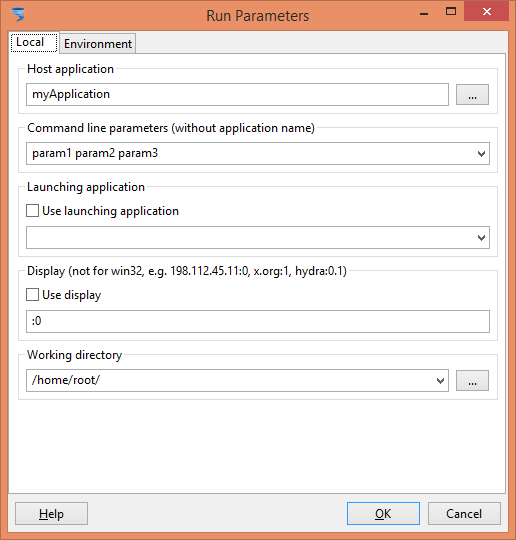
- Set "Run parameters"
For remote debug we need to set the correct value for "Host application", "Command line parameters" and "Working directory". Remember: It is remote!
- Step 7
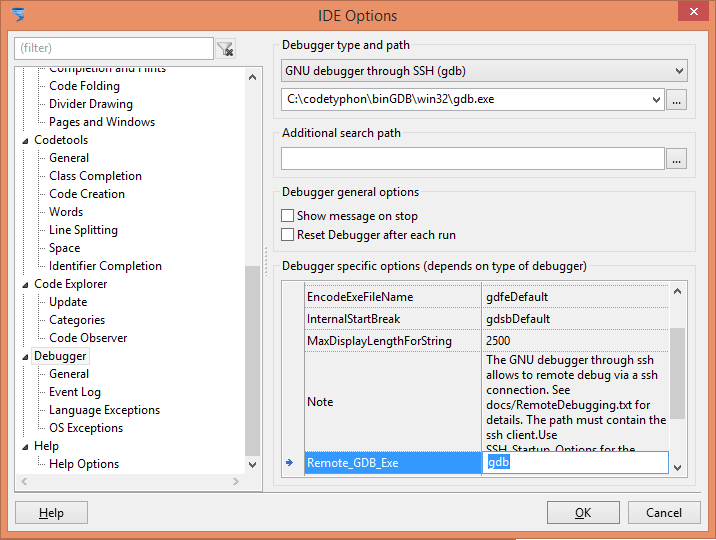
- Set "Debugger parameters"
Select "Debugger type and path" to "GNU Debugger trough SSH(ssh)"
 ToDo
Using gdbserver
For now this is the best approach I could find: Steps for remote debugging from Windows to Linux machine, other situations should not be so much different:
1- Manually include gdbmidebugger the public "uses" clause of debugmanager.pas file located in lazarus/ide and recompile ide.
2- Install gdb and gdbserver on Linux.
3- Make a cross compile Lazarus.
4- Set IDE options/Debugger to gdbserver and in the debugger options on the bottom set Debugger_Remote_Hostname to remote Linux machine IP or name and set the port to 2159.
5- Add a Linux build mode to project option.
6- Build project on Linux build mode.
7- Use whatever tool like WinSCP to move binary file to Linux machine. for WinSCP use it like this : WinSCP.com /script=script.txt and content of script.txt will be like this (you can use WinSCP 5.8 and later session/ script menu to make and modify it) :
open sftp://username:remotepassword@remotenameorip/ -hostkey="XXXXXX"

cd ./projectdir
put -permissions=744 "C:\Project\project1"

exit
8- Run gdbserver on remote machine like this : gdbserver host:2159 ./project1
9- Set breakpoints where you want.
10- Run project in your IDE and test it.
For more reading see :
- http://forum.lazarus.freepascal.org/index.php/topic,32393.0.html Remote debugging from Windows to Linux
- http://forum.lazarus.freepascal.org/index.php/topic,19014.msg107930.html#msg107930 Initial GdbServer post on forum
- http://forum.lazarus.freepascal.org/index.php/topic,20101.msg115408.html#msg115408 target async support (ssh and gdbserver)
Using avr-gdb
I've managed to debug AVR programs using two different methods:
Executing code through simavr (an AVR simulator)
simavr includes a gdbserver interface. To simulate and debug code, launch simavr with the -g option:
./runavr -g -m atmega328p -f 16000000 <firmware>By default a remote gdb connection is available on port 1234.
Running on hardware and debugging over DEBUGwire using dwire-debug
Launch dwire as follows:
./dwdebug device <serial port>, gdbserver, qrBy default a remote gdb connection is available on port 4444. The qr option will result in dwire exiting with the target running when the debug connection is killed. Note that currently dwire returns S00 when hitting a breakpoint. This results in Lazarus displaying a popup dialog with an error message. This is to indicate that a non-standard signal was received and is merely an annoyance. See this for a fix.
To configure Lazarus for debugging over avr-gdb
- Select GNU remote debugger under Debugger options
- Enter path to avr-gdb
- Enter the appropriate port number
- At the moment a Lazarus patch is required because no process ID is available on the embedded platform.
I've tested different versions of gdb compiled for AVR target:
- gdb 6.6 - Doesn't work because async mode isn't supported.
- gdb 7.0.1 -
WorksSometimes work, see note below. - gdb 8.0 - Doesn't work as is, but work with this patch.
Note: After I upgraded Linux Mint and retested gdb 7.0.1 I noticed the following warning while testing a debug session:
warning: (Internal error: pc 0xa2 in read in psymtab, but not in symtab.) GDB would sometimes not work properly and debugging from Lazarus using this version of gdb could hang the IDE.