This article applies to iOS only.
See also: Multiplatform Programming Guide
About
iPhone Laz extension is Lazarus IDE extension that's designed to simplify iPhone applications development.
Before you use the extension, it's recommended to learn the page about iPhone/iPod development.
The extension does NOT provide another LCL WidgetSet (like Carbon or Cocoa) nor requires to use any.
Author
Dmitry 'skalogryz' Boyarintsev
email: skalogryz dot lists at gmail dot com
License
modified LGPL (same as the FPC RTL and the Lazarus LCL). You can contact the author if the modified LGPL doesn't work with your project licensing.
Download
The latest stable release can be found at svn:
svn co https://lazarus-ccr.svn.sourceforge.net/svnroot/lazarus-ccr/components/iphonelazextChange Log
- Version 0.5 05 Jan 2010
- Version 0.7 Feb 2013
Dependencies / System Requirements
- Lazarus 0.9.29 (SVN trunk) or higher. (for Project options integration)
- Mac OS X 10.5 (Intel) + iPhoneSDK/Xcode 3.1 or higher
- Mac OS X 10.6 + iPhoneSDK/Xcode
- FPC 2.4.0 (FPC 2.5.1 (or higher) with Objective-P syntax is recommended to use).
- Since Apple doesn't provide any tools for development on other than OS X system, the package cannot (should not) be installed and used on Windows or Linux.
Status: Beta
Known Issues:
- Project launched from Lazarus fails with an exception. It should be launched from the iPhone simulator
- The project, using iPhoneAll unit, compiled for the simulator must use Smart Linking switch (-XX)
- When application's title is changed (in Project options) a string is added to the main file
Application.Title:='MyApp';It must be deleted manually
- XCode sometimes fails to debug the application on iDevice, though it's loaded successfully. Don't worry. Your application is still on the iDevice and ready to be tested.
- todo:
To do:
- Improve debugging abilities
Installation
In order to develop for iPhone or iPod, you'll need arm FPC compiler with rtl and packages installed in the system. There're 2 ways to do it: built manually via SVN or installed from a special FPC arm package. Both ways are described here.
You don't need to install ARM compiler or packages, if you're planning to use iPhone simulator only.
- Get the package source via svn or download from Sourceforge
- Open and install the package
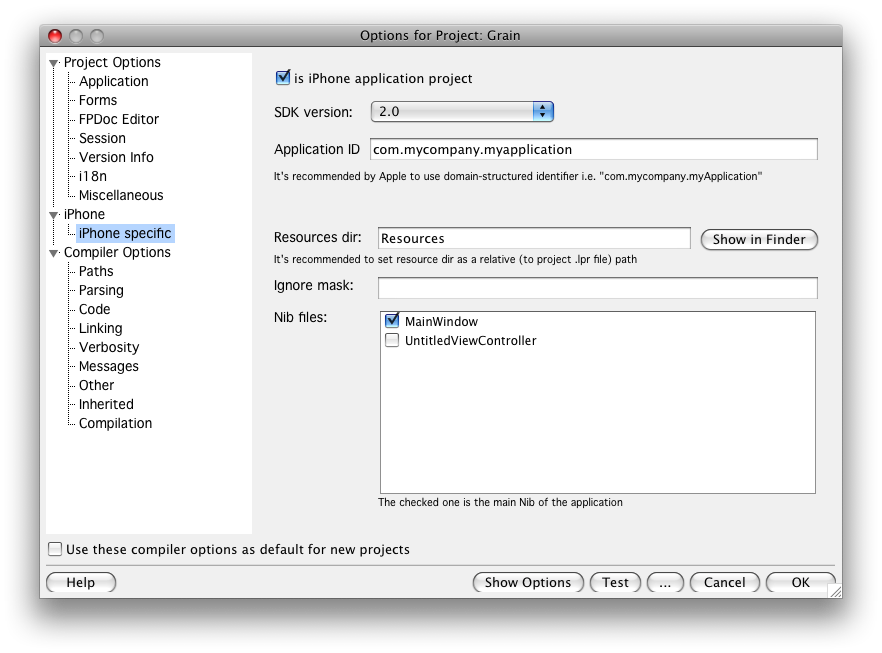
- You will find iPhone options group added to both Project and Environment options
How to use
Common usage
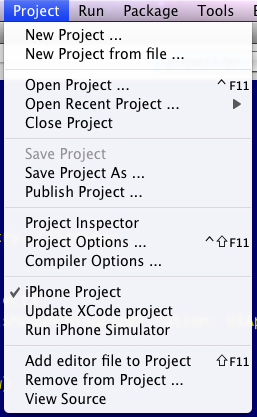
- Mark a project as iPhone project (using Project menu -> is iPhone project or Project Options -> iPhone -> is Phone project application)
- To change the displayed name of the application you must change the application Title in Project Options.
- You can also change the application icon in the same way
iPhone Simulator
- To install the application to iPhone simulator you need simply to build the project (ctrl+F9/cmd+B).
The installation is always performed then you try to build the project.
iPhone simulator apps require special environment, created by the simulator or they will fail with "trace error" if run in pure OSX. To make the simulator Run everytime you're running the application, select in menu "Run->Run parameters..." check "Use launching application" put there
'/Developer/Platforms/iPhoneSimulator.platform/Developer/Applications/iPhone Simulator.app/Contents/MacOS/iPhone Simulator'Note: the location of iPhone simulator.app may vary, depending on the iPhone SDK installation path.
It's not required, but you'll need to launch iPhoneSim manually otherwise.
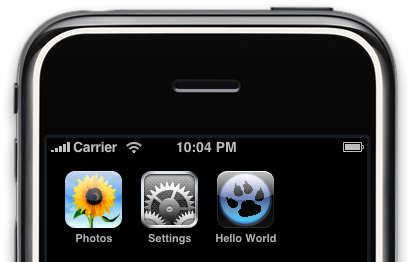
- After you build run the iPhone Simulator, your application should be on the one of the iPhone simulated pages.
It's possible, that iPhone sim also starts the required application (as Xcode does), but this possibility is undocumented by Apple. You can use it on your own risk. Please refer to http://github.com/jhaynie/iphonesim
Project to Xcode
There's not way to install an application to iPhone, but using Xcode (or purchasing it via iTunes). (Jailbreaks have their own way, not used by the package). The package provides an utility to generate an Xcode project from Lazarus project.
- Write the program (and test it on the Simulator, if necessary)
- Select Project -> Update XCode project. If not exists xcode directory is selected there you'll find xcode project. If project exists, it's configuration will be updated
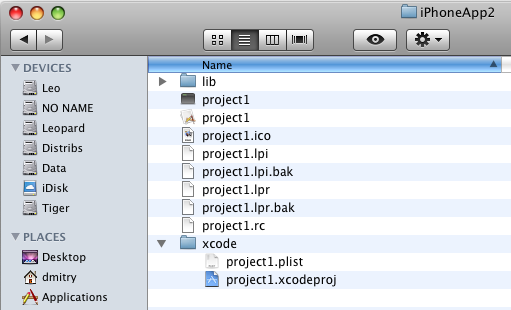
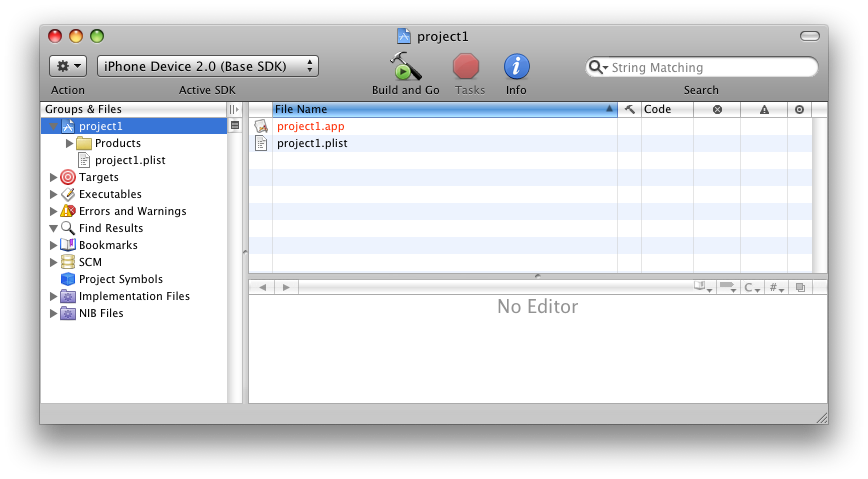
- Open the project (project1.xcodeproj on the screenshot) . Select iPhone device for as Active SDK.
- You might need to specify Code identity in Build configuration (please, refer to iPhone Developer program portal)
- Press Build and Go. This should build the application and install it to iPhone device.
Note:
- You'll need arm-darwin FPC compiler installed and configured. Any units or package used, must be compiled for arm-darwin target as well.
- Created XCode project, is not flexible enough to build the project for iPhone Simulator, so make sure that iPhone OS is used as active SDK.
Examples
The extension also includes a few sample projects. (see examples dir at the iphonelazext directory)
Hello World
The sample requires a objective-p compiler (fpc 2.5.1 or higher) with cocoaint packages compiled for iPhone
 program project1;

 {$mode objfpc}{$H+}
 {$modeswitch objectivec1}
 {$linkframework UIKit}

 uses
   iPhoneAll, CGContext, CGGeometry, CFString;

 type
   TAppDelegate = objcclass(NSObject)
     procedure applicationDidFinishLaunching(application: UIApplication); message 'applicationDidFinishLaunching:';
   end;

   TMyWindow = objcclass(UIWindow)
   public
     procedure drawRect(c: CGRect); override;
   end;

 const
   helloworld = 'Hello world';

 // window paint method
 procedure TMyWindow.drawRect(c: CGRect);
 var
   cg : CGContextRef;
 begin
   // getting current context
   cg:=UIGraphicsGetCurrentContext;
   // setting back ground color
   CGContextSetRGBFillColor(cg, 0, 0, 0.5, 1);
   CGContextFillRect(cg, c);

   // rotating up-side down context
   CGContextTranslateCTM(cg, 0, c.size.height);
   CGContextScaleCTM(cg, 1, -1);

   // setting text color
   CGContextSetRGBFillColor(cg, 1, 1, 0, 1);
   CGContextSetRGBStrokeColor(cg, 1, 1, 0, 1);
   // setting font  (must set any)
   CGContextSelectFont(cg, 'Helvetica', 30, kCGEncodingMacRoman);
   // rendering text
   CGContextShowTextAtPoint(cg, 0, c.size.height-50, helloworld, length(helloworld));
 end;

 var
   mainwindow : TMyWindow;

 { TAppDelegate }

 procedure TAppDelegate.applicationDidFinishLaunching(application: UIApplication);
 begin
   // application has initialized, now we can create the main window
   mainwindow:=TMyWindow(TMyWindow.alloc);
   // initialize window in Objective-C style
   mainwindow := TMyWindow(mainwindow.initWithFrame (UIScreen.mainScreen.bounds));
   // activate and show the window
   mainwindow.makeKeyAndVisible;
 end;

 function NSStr(const s: string): NSString;
 begin
   // converting string to NSString (CFStringRef and NSString are interchangable)
   Result:=NSString( CFStr(PChar(s)));
 end;

 var
   pool    : NSAutoreleasePool;
 begin
   // initialize foundation memory manger (aka autorelease pool)
   pool := NSAutoreleasePool.alloc.init;
   // launching main application loop
   ExitCode:=UIApplicationMain(argc, argv, nil, NSSTR('TAppDelegate'));
   // according to docs the UIApplicationMain never returns,
   // but still the code present in the Obj-C main.m files
   pool.release;
 end.
The result would look like:

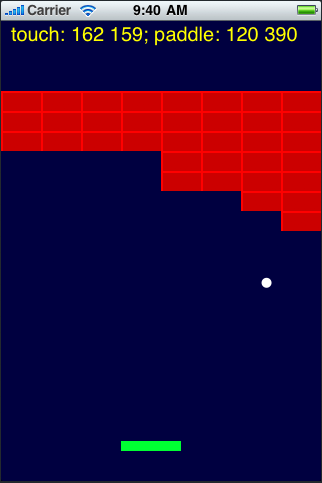
iArkanoid
Written from scratch simple arkanoid game UIKit and GoreGraphics games for iPhone/iPod.