

About
fpcup is a tool that automates running a subversion client to build FPC and/or Lazarus in a self-contained directory structure. It is meant as a thin wrapper around the regular manual svn up/make/make install build process.
Think of it as a batch file on steroids that does the boring svn work for you.
On Windows, it can also serve as a "bare metal" installer: it can download a subversion client, binutils (make.exe etc).
fpcup allows maintaining multiple different FPC/Lazarus combinations.
It is a third party tool, not part of FPC or Lazarus.
The fpcup GUI which is provided with the source code:
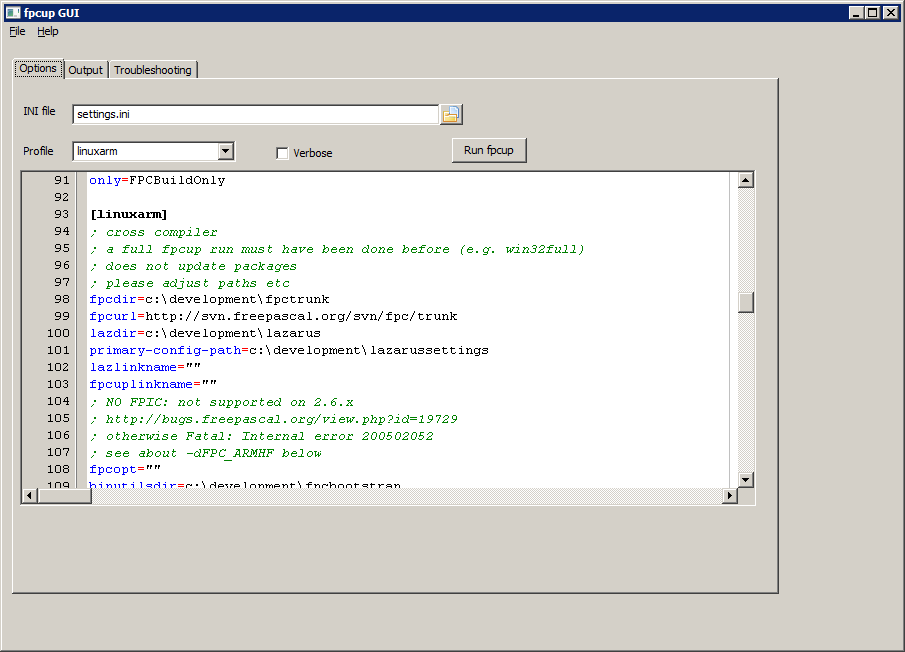
Ready to run
fpcup is ready to run out of the box. It will download and install FPC and Lazarus. On Windows, this directory layout is used:
C:\development\config_lazarus # Default primary-config-path directory
                              # (contains Lazarus settings)
C:\development\cross          # Place to store cross compiling binutils and libs if wanted
C:\development\extras         # Third party modules (see fpcup.ini) such as fpcdocs
C:\development\fpcbootstrap   # Binutils (make.exe etc) and bootstrap compiler
C:\development\fpc            # FPC fixes 2.6 by default
C:\development\lazarus        # Lazarus trunk by default
On Linux/OSX/BSD, a similar layout is used under ~ (the user's home directory).
fpcup will create a shortcut to the installed Lazarus on your desktop.
Just run fpcup, e.g. on Windows:
fpcupOn *nix:
#replace fpcup_linux_x86 with your actual fpcup filename of course if not on linux x86
chmod u+rx fpcup_linux_x86 #make executable (one time only action)
./fpcup_linux_x86 #run
Next time, you can either run the exact same command, or run the fpcup_update desktop shortcut or home directory shell script/batch file.
Documentation
fpcup has
- a -h option
- a readme.txt
- fpcup.html with development notes
See the source code repository for the latest readme.txt and fpcup.html.
To make it easier to get user contributions for documentation/tips, this wiki page has been created. Please feel free to add your own examples etc.
Tips
Anchordocking
One way to enable anchordocking is by using settings.ini:
open your settings file or add a new file settings.ini
[anchordocking]
; Just a plain install except enable anchordocking package
anchordocking=1
This will use default settings but also enable the anchordocking package in the IDE.
Of course, you can use the anchordocking=1 module setting in any .ini section.
Building only FPC
You can build FPC without Lazarus if you want (or the other way round). The example below builds FPC from the fixes 2.6 SVN branch.
Settings
Open your settings file or add a new file, settings.ini:
[fixes26]
; FPC 2.6 fixes only (no Lazarus)
fpcdir=c:\development\fpcfixes26
fpcurl=http://svn.freepascal.org/svn/fpc/branches/fixes_2_6
; Let's specify Lazarus info in case we ever want to add lazarus
lazdir=c:\development\lazarus12_fixes26
; Just an example: build Lazarus 1.2:
lazurl=http://svn.freepascal.org/svn/lazarus/tags/lazarus_1_2
primary-config-path=c:\development\configlazarus12_fixes26
; If we ever build Lazarus, do create a link/shortcut:
lazlinkname=lazarus12_fixes26
; Do not create a batch file with shortcut
fpcuplinkname=""
; We can use the binutils/bootstrap dirs that we usually use:
binutilsdir=c:\development\fpcbootstrap
fpcbootstrapdir=c:\development\fpcbootstrap
; Just install/update, no questions asked:
noconfirm=true
; In case you want to submit patches, it's nice to be able to update
; without overwriting your fixes:
keeplocalchanges=true
; Specify we only want FPC, not Lazarus
; in case of fpc patches FPCBuildOnly
only=FPC,FPCCrossWin32-64
skip=helplazarus,lazarus,lazbuild,bigide,useride
Then get FPC and build it with:
fpcup --inifile=settings.ini --inisection=fixes26Now you can run your compiler:
c:\development\fpcfixes26\bin\i386-win32\fpc.exe -hCross-compile for win64, e.g.:
c:\development\fpcfixes26\bin\i386-win32\fpc.exe -Px86_64 yourfile.pasAvoid lengthy lcl.chm documentation generation
By default, fpcup tries to compile the $(lazarusdir)\docs\chm\lcl.chm Lazarus help file every day or so. This can take a long time due to the fpdoc tool being quite slow.
You can avoid compiling lcl.chm by generating it one time (or copying over an existing file) and making the file read-only.
Cross compilers
fpcup not only lets you install native FPC/Lazarus, but will also build cross compilers for you.
For most cross compilers, you do need to have the relevant binutils that are specific for the host<>target system.
Often, you will also need libraries in target system format if you want to compile programs (e.g. Linux Qt or Gtk libraries for the relevant CPU if you're crosscompiling for Linux).
When you run a crosscompiler, fpcup briefly checks if it can find required binutils and libraries and will warn you if they can't be found.
Status
- Built in means no additional files are needed
- Needs binutils/libs: means that you need to supply those (see above)
- N/A: means non-applicable/impossible
- No: means no plans to implement this. However, contributions are welcome, as always
| From\To | DOS | GO32v2 | Windows x86 | Windows x64 | Linux x64 | Linux x86 | Linux mipsel | Linux arm | Android ARM | FreeBSD x64 | FreeBSD x86 | OSX | AIX powerpc32 |
| Any | needs binutils,libs | needs binutils,libs | needs binutils,libs | needs binutils,libs | |||||||||
| Windows x86 | needs FPC trunk, binutils | yes, built in | N/A | yes | needs binutils,libs | needs binutils,libs | see Any | see Any | See Any | ||||
| Windows x64 | no | no due to FPC limitations | needs FPC trunk | N/A | needs binutils,libs | needs binutils,libs | see Any | see Any | See Any | ||||
| Linux x64 | no | yes, built in | N/A | see Any | see Any | no plans | no plans | See Any | |||||
| Linux x86 | yes, built in | N/A | see Any | see Any | no plans | no plans | See Any | ||||||
| Linux mipsel | N/A | see Any | See Any | ||||||||||
| Linux arm | see Any | N/A | See Any | ||||||||||
| Android ARM | see Any | see Any | N/A | See Any | |||||||||
| FreeBSD x64 | no | no plans | yes, built in | see Any | see Any | N/A | See Any | ||||||
| FreeBSD x86 | no plans | yes, built in | see Any | see Any | N/A | See Any | |||||||
| OSX | verify | see Any | see Any | N/A | See Any |
(With thanks to FPSpreadsheet's spreadsheet to wikitable conversion tool, see e.g. examples\fpsgrid)
AIX PowerPC crosscompiler
Once you have set up a regular FPC trunk/2.7.1 compiler, you can add an FPC AIX Port cross compiler.
Limitations:
- FPC trunk/2.7.1+ only
- untested; don't have target platform libs (or access to target platform). Test reports welcome.
Required files
- Crossbinutils: see wiki article mentioned earlier. Win32 cross binutils are provided; for *nix, you have to compile your own.
- Libs: copy over from target device; see wiki article as well.
Settings
Open your settings file or add a new file, settings.ini:
[aix]
; AIX on powerpc32 cross compiler. Also runs on 64 bit powerpc
; a full fpcup run must have been done before
; please adjust paths etc
fpcdir=c:\development\fpctrunk
fpcurl=http://svn.freepascal.org/svn/fpc/trunk
fpcopt=""
fpcuplinkname=""
lazlinkname=""
binutilsdir=c:\development\fpcbootstrap
fpcbootstrapdir=c:\development\fpcbootstrap
noconfirm=true
keeplocalchanges=true
cputarget=powerpc
fpcopt=""
crossopt=""
ostarget=aix
; Perhaps best to always clean... can be removed for speed
only=FPCCleanOnly,FPCBuildOnly
skip=FPCGetOnly,lazbuild,bigide,useride
See also:
- any (cross compiler) page about your device
- your AIX documentation
Creating and using the cross compiler
Then generate the cross compiler with
fpcup --inifile=settings.ini --inisection=aixIf, like me, you don't have the libs from the target platform and run with --verbose, you'll see something like:
C:\development\cross\bin\powerpc-aix\powerpc-aix-ld.exe: cannot find \lib\crt0.o
C:\development\cross\bin\powerpc-aix\powerpc-aix-ld.exe: cannot find -lm
C:\development\cross\bin\powerpc-aix\powerpc-aix-ld.exe: cannot find -lc
C:\development\cross\bin\powerpc-aix\powerpc-aix-ld.exe: cannot find -lbsd
If the compiler generation went ok, you can run a test compile, compiling a file test.pas with
- option -CN: avoid reading for null pointers on AIX; see wiki article
fpc -Ppowerpc -Taix -CN test.pas(your fpc.cfg will have been modified to add some settings when cross-compiling to Android ARM)
Android ARM crosscompiler
Once you have set up a regular FPC trunk/2.7.1 compiler, you can add an Android cross compiler.
Limitations:
- only tested on FPC trunk
- only builds FPC cross compiler, Android does not have "regular" LCL support so not enabled
- patches for getting customdrawn support going are welcome
Required files
Download the Android NDK (e.g. a file like android-sdk_r22.3-windows.zip) for your platform and extract the crossbinutils, e.g. from a path like
android-ndk-r9c\toolchains\arm-linux-androideabi-4.8\prebuilt\windows-x86_64\binThe result is something like these files (adjust for your platform etc):
arm-linux-androideabi-addr2line.exe
arm-linux-androideabi-ar.exe
arm-linux-androideabi-as.exe
arm-linux-androideabi-c++.exe
arm-linux-androideabi-c++filt.exe
arm-linux-androideabi-cpp.exe
arm-linux-androideabi-elfedit.exe
arm-linux-androideabi-g++.exe
arm-linux-androideabi-gcc-4.8.exe
arm-linux-androideabi-gcc-ar.exe
arm-linux-androideabi-gcc-nm.exe
arm-linux-androideabi-gcc-ranlib.exe
arm-linux-androideabi-gcc.exe
arm-linux-androideabi-gcov.exe
arm-linux-androideabi-gdb-orig.exe
arm-linux-androideabi-gdb.exe
arm-linux-androideabi-gprof.exe
arm-linux-androideabi-ld.bfd.exe
arm-linux-androideabi-ld.exe
arm-linux-androideabi-ld.gold.exe
arm-linux-androideabi-ld.mcld.exe
arm-linux-androideabi-nm.exe
arm-linux-androideabi-objcopy.exe
arm-linux-androideabi-objdump.exe
arm-linux-androideabi-ranlib.exe
arm-linux-androideabi-readelf.exe
arm-linux-androideabi-size.exe
arm-linux-androideabi-strings.exe
arm-linux-androideabi-strip.exe
Put these files in your cross binutils directory for the right platform - e.g. on a standard Windows fpcup install:
C:\development\cross\bin\arm-androidLibs: extract the libs from a path like
android-ndk-r9c\platforms\android-19\arch-arm\usr\libinto
C:\development\cross\lib\arm-androidThe libs in question can be like this list:
crtbegin_dynamic.o
crtbegin_so.o
crtbegin_static.o
crtend_android.o
crtend_so.o
libandroid.so
libc.a
libc.so
libdl.so
libEGL.so
libGLESv1_CM.so
libGLESv2.so
libGLESv3.so
libjnigraphics.so
liblog.so
libm.a
libm.so
libm_hard.a
libOpenMAXAL.so
libOpenSLES.so
libstdc++.a
libstdc++.so
libthread_db.so
libz.so
rs
Settings
Open your settings file or add a new file, settings.ini:
[android]
; Android ARM cross compiler
; a full fpcup run must have been done before
; please adjust paths etc
fpcdir=c:\development\fpctrunk
fpcurl=http://svn.freepascal.org/svn/fpc/trunk
fpcopt=""
fpcuplinkname=""
lazlinkname=""
binutilsdir=c:\development\fpcbootstrap
fpcbootstrapdir=c:\development\fpcbootstrap
cputarget=arm
ostarget=android
; You can specify exact instruction set and floating point support etc:
crossopt="-CpARMV7 -CfVFPV3"
; ... or something more conservative/compatible:
;crossopt="-CpARMV6"
verbose=0
; We only need an FPC here; assume FPC has been updated by regular update
only=FPCBuildOnly
; No LCL support on Android yet
See also:
- ARM compiler options
- any (cross compiler) page about your device
- your ARM device documentation
Creating and using the cross compiler
Then generate the cross compiler with
fpcup --inifile=settings.ini --inisection=androidNow you can run a test compile, compiling a file test.pas with
fpc -Parm -Tandroid test.pas(your fpc.cfg will have been modified to add some settings when cross-compiling to Android ARM)
Linux ARM cross compiler
Once you have set up a regular FPC compiler, you can add an Linux on ARM cross compiler (e.g. for a Raspbian/Raspberry Pi).
Required files
- Linux/Unix build or install the relevant crossbinutils (Linux, unix)
- Windows: download the binutils from http://svn2.freepascal.org/svn/fpcbuild/binaries/i386-win32 (the files starting with arm-linux-) Put them into
C:\development\cross\lib\arm-linuxOn Windows, the result is something like these files (adjust for your platform etc):
arm-linux-addr2line.exe
arm-linux-ar.exe
arm-linux-as.exe
arm-linux-ld.exe
arm-linux-objcopy.exe
arm-linux-objdump.exe
arm-linux-strip.exe
Libs: extract the libs from your device - e.g. this on Raspbian:
- all .so files in /lib
- all .so files in /usr/lib
- all .so files in /usr/lib/arm-linux-gnueabihf
Note: some .so files are actually scripts; check
grep -i "ld script" *Remove those .so and copy over (or symlink) the .so.x to .so in order for the linker to find them Examples: libpthread.so libc.so libgcc_s.so
put them into your cross lib path, e.g. on Windows
C:\development\cross\lib\arm-linuxSettings
Open your settings file or add a new file, settings.ini.
As you can see in the comments below, you can build an ARMHF cross-compiler which works on e.g. Raspbian, requires an FPU and requires ARMHF libraries, but only on FPC 2.7+.
[linuxarm]
; a full fpcup run must have been done before (e.g. win32full)
; does not update packages
; please adjust paths etc
fpcdir=c:\development\fpctrunk
fpcurl=http://svn.freepascal.org/svn/fpc/trunk
lazdir=lazdir=c:\development\lazarus
primary-config-path=c:\development\lazarussettings
lazlinkname=""
fpcuplinkname=""
; NO FPIC: not supported on 2.6.x
; http://bugs.freepascal.org/view.php?id=19729
; otherwise Fatal: Internal error 200502052
; If using -CaEABIHF in crossopt, specify -dFPC_ARMHF here (only works on 2.7.x)
; more info see below
fpcopt=""
binutilsdir=c:\development\fpcbootstrap
fpcbootstrapdir=c:\development\fpcbootstrap
noconfirm=true
keeplocalchanges=true
cputarget=arm
; if using armhf, you MUST specify -dFPC_ARMHF in the FPC options;
; specifying in crossopt is not enough.
; -fPIC not supported on FPC 2.6.x, only on 2.7.x;
fpcopt="-dFPC_ARMHF"

; safe default but slow:
;crossopt="-CpARMV6 -CaEABI -CfSOFT"

; Raspbian for Raspberry Pi safe
; ARMv6 instruction set
; if using arm hf (hard float/floating point), please specify -dFPC_ARMHF
; copy over /lib, /usr/lib
; /usr/lib/arm-linux-gnueabihf (Raspbian) => note:
; some .so files are actually scripts; check
; grep -i "ld script" *
; Remove those .so and copy over (or symlink) the .so.x to .so in order for the linker to find them
; Examples:
; libpthread.so
; libc.so
; libgcc_s.so
; to cross lib dir (try compiling and keep copying until no errors left)
; Note: -CpARMV6Z parameter not supported on 2.6.x, only on 2.7.x
; Note: -CaEABIHF parameter not supported on 2.6.x, only on 2.7.x
; Note: don't use -fPIC; will give segmentation fault
crossopt="-CaEABIHF -CpARMV6 -CfVFPV2"

; beagleboard black with hardfloat:
; if using armhf, also specify -dFPC_ARMHF (in fpcopt) to avoid gtk scrollbar errors
; Note: -CaEABIHF not supported on 2.6.x, only on 2.7.x
;crossopt="-CaEABIHF -Cparmv7 -CfVFPv3"
ostarget=linux
; we only need to do Lazarus as FPC won't change here
only=FPCCleanOnly,FPCBuildOnly
skip=FPCGetOnly,lazbuild,bigide,useride
See also:
- ARM compiler options
- any (cross compiler) page about your device
- your ARM device documentation
Creating and using the cross compiler
Then generate the cross compiler with
fpcup --inifile=settings.ini --inisection=linuxarmNow you can run a test compile, compiling a file test.pas with
fpc -Parm -Tlinux test.pas(your fpc.cfg will have been modified to add some settings when cross-compiling to Android ARM)
DOS crosscompiler
Using 32 bit fpcup.exe on Windows, once you have set up a regular FPC trunk/2.7.1 compiler, you can add a DOS cross compiler.
Required files
Download the required binaries as mentioned in DOS, currently:
msdos-nasm.exe
msdos-wlib.exe
msdos-wlink.exe
nasm.exe
wlibd.dll
wlinkd.dll
wlsystem.lnk
and put them in your cross binutils directory for the right platform - e.g. on a standard Windows fpcup install:
c:\development\cross\bin\i8086-msdosThere are no files needed in the corresponding library directory,
C:\development\cross\lib\i8086-msdosSettings
Open your settings file or add a new file, settings.ini:
[dos]
; dos cross compiler
; a full fpcup run must have been done before
; please adjust paths etc
fpcdir=c:\development\fpctrunk
fpcurl=http://svn.freepascal.org/svn/fpc/trunk
fpcopt=""
fpcuplinkname=""
lazlinkname=""
binutilsdir=c:\development\fpcbootstrap
fpcbootstrapdir=c:\development\fpcbootstrap
cputarget=i8086
ostarget=msdos
verbose=0
; We only need an FPC here; assume FPC has been updated by regular update
only=FPCBuildOnly
Creating and using the cross compiler
Then generate the cross compiler with
fpcup --inifile=settings.ini --inisection=dosNow you can run a test compile, compiling a file test.pas with
fpc -Pi8086 -TMSDOS test.pas(your fpc.cfg will have been modified to use DOS medium memory model, smartlinking etc)
Download
The official site is at: https://bitbucket.org/reiniero/fpcup/downloads
Windows users, please download the 32 bit fpcup version even if you are on 64 bit Windows unless you know what you are doing. See this warning about FPC 2.6.x x64.
License
fpcup is open source software released under the LGPL with linking exception (same as FreePascal/LCL).
Troubleshooting
When you hit errors with fpcup:
- If you have a working Lazarus, run Tools > Rescan FPC Source Directory
- Try running fpcup with
--verboseto see what's going on exactly. - Look into the error message fpcup generates; it also shows some troubleshooting steps you may perform.
- Sometimes, the FPC or Lazarus build process leaves incorrect files; you can delete all .ppu files from your FPC and Lazarus directories (including subdirectories) and run fpcup again.
- Try removing all intermediate files by running fpcup with the
--cleanoption - If compiling Lazarus, make sure lazarus and lhelp are not running.
- Try running
svn revert THEDIRECTORY --recursivefollowed by
svn update THEDIRECTORYfor your Lazarus and FPC directories to remove local modifications, if any.
- Remove possible stale files:
- the bootstrap compiler and any binutils: remove all files and directories in the fpcbootstrap directory
- if you haven't modified fpcup.ini, remove it and let fpcup regenerate it
- same for settings.ini
- same for fpc.cfg in $(fpcdir)\bin\<architecture>
- same for your Lazarus primary config path/configuration directory
- See if there's a newer fpcup version available that may have fixed your problem
If the steps before do not work: you can use the --uninstall option to remove all files including your FPC and Lazarus directories, then run fpcup with the same commands.
Of course, errors introduced in FPC and Lazarus source code/repository may also influence builds. There's nothing fpcup can do to fix incorrect code breaking the build. However, some of the steps mentioned above (deleting .ppu files, fpc.cfg, Lazarus config) may fix Lazarus/FPC build problems..
Known issues
Known issues can be found in the issue tracker: https://bitbucket.org/reiniero/fpcup/issues?status=new&status=open
Strange errors running clean/distclean
This is a symptom of issues with the FPC build system (not fpcup).
On Windows, make 3.80 which is distributed with FPC 2.6.x has problems when there are spaces in your path. This may lead to strang error messages when cleaning. Solution: download make 3.81 or make 3.82. Make 3.82 is newer, but cannot build FPC 2.6.x; it builds FPC 2.7.x fine, though.
Info: Error running fpcup. Technical details: error executing sequence helplazarus; line: 4, param: helplazarus
HelpLazarus is often the first module that will be built after building lazbuild and the other core IDE units. However, the actual problem may be that lazbuild itself was not generated due to an error. Try running with --verbose to pinpoint where the problem is and follow the troubleshooting steps above.
Error finding (e.g.) system.ppu when compiling with FPC/Lazarus
Try running Tools > Rescan FPC Source Directory
Errors like this may be caused by an fpc.cfg from an older/different version of FPC that remains in your fpc/bin/<platform> directory. Because you can customise fpc.cfg, fpcup will not just replace it.
If you have not customised fpc.cfg, you can remove it and let fpcup regenerate it when rebuilding FPC.
Support and bug reporting
Please post support requests on the forum so other users can help you.
Please report fpcup bugs on the bug tracker https://bitbucket.org/reiniero/fpcup/issues
If you report bugs, after running the troubleshooting steps above, please be sure to mention:
- operating system
- fpcup version (as printed in its output)
- description of what went wrong/error message
- run fpcup with the
--verbose --noconfirmarguments (or the equivalents in settings.ini) as well as the other arguments you used, redirect the output to file, and attach the file, e.g.:
fpcup --verbose --noconfirm > fpcupverbose.txt.
Current status
- Support for Windows 2000-7 (Windows 8: untested, probably works). Bare metal install currently needs Windows XP or later for the subversion client. On Windows 2000, manually installing a subversion client in advance will work.
- Linux x86: works
- Linux x64: works
- Linux ARMHF: lightly tested; seems to work
- OSX 10.?: lightly tested; seems to work
- FreeBSD 9: lightly tested; seems to work
Changelog
This log tracks fpcup binaries as available on the download page. Note that not all binaries may be updated at the same time; fpcup prints a version string at the beginning which you can check.
For more details, please see the Mercurial commit log in https://bitbucket.org/reiniero/fpcup/commits/all
- 20140512:
- Use FPC 2.6.4 bootstrap compilers for OSX and FreeBSD. Remove existing bootstrap compilers to update.
- 20140501:
- Fix Synapse download location. Please backup & delete fpcup.ini for changes to take effect. You may also need to delete the extras\synapse directory in advance.
- 20140408:
- Fix for *nix cross compiling on multiple cores
- 20140316:
- FPC builds in parallel (make --jobs=<n> /FPMAKEOPT=--threads=<n>) where n=the number of CPU cores (incl. hyperthreading) on Unix/Linux. Disabled for now on Windows due to reported problems with make 3.80
- Addition of FPC 2.6.4 URL alias to fpcup.ini (as usual DELETE FPCUP.INI and let fpcup recreate if wanted)
- More error handling for out of disk space situations. Thanks nomorelogic
- 20140228:
- Windows: get Make.exe 3.80 instead of 3.82. Even though it's distributed with Laz 1.2RC. Should fix FPC 2.6.x builds/clean issues, but will have problems with paths with spaces in name. REMOVE existing make.exe from FPCBOOTSTRAP directory if you want to get make 3.80
- Some fpcup.ini/settings.ini fixes. PLEASE REMOVE AUTOGENERATED fpcup.ini AND settings.ini to let fpcup regenerate them
- Don't build startlazarus if it already exists.
- Let universal installer/external installer rebuild Lazarus if needed so newly included packages appear in the IDE (should be no need for manual recompile anymore)
- Build lcl.chm if writable and older than 7 days instead of 1 day. LCL.chm content does not change that much
- Cross compiled LCL is not cleaned (via make distclean) anymore as this removes lazbuild.exe, lazarus.exe. Cleaning can still be done via explicit --only=.... options (see fpcup --help for the various clean sequences)
- Odroid: update is default setting in fpcupodroid.ini now (instead of full install)
- 20140128:
- Build startlazarus when building useride. Although the regular lazarus build should have built startlazarus, it apparently was not present.
- Run useride build process twice to try and deal with packages being marked for installation but not actually being built on IDE build.
- Revert back to make 3.80 on Windows as make 3.82 does not work with FPC 2.6.x even though Lazarus 1.2RC2 is distributed with it. If needed, you can delete existing make.exe from your fpcbootstrap directory before running fpcup.
- Bug fix: Win64: remove libexpat-1.dll download as it doesn't exist remotely
- 20140127:
- GUI: allow running without noconfirm in ini file (avoids yes/no question that can never be answered)
- Fix a bug in fpcup that disallows running noconfirm
- 20140125:
- Support fpcres resource compiler in trunk FPC on *nix being in "plain bin dir", not architecture dependent bin dir. PLEASE REMOVE EXISTING FPC.CFG and FPC.SH AS THEY NEED TO BE CHANGED.
- Follow Lazarus 1.2RC2+FPC2.6.2 and use make 3.82 instead of 3.80 on win32. Please remove existing make.exe from your fpcbootstrap directory
- Much improved Linux ARM(HF native compiler
- Improve console output: more clearly mark what is fpcup and what is generated by FPC/Lazarus make/lazbuild etc
- Give exit code 64 if fpcup run fails
- GUI: troubleshooting tool (delete .ppu/.a/.o)
- 20140113:
- Experimental AIX cross compiler module.
- 20140111:
- Working fpc fixes 2.6 cross compiler for Linux ARM (e.g. Raspbian).
- 20131231:
- Add --crossOPT option that lets you pass options to cross compilers. Useful for e.g. specifying softfloat or hardfloat on ARM/MIPS processors. See example in settings.ini Please delete settings.ini and let fpcup regenerate it.
- 20131230:
- cross compiler modules not only add but also update fpc.cfg configuration snippets.
Snippet format changed: PLEASE REMOVE ALL # fpcup do not remove snippets from fpc.cfg or entire fpc.cfg and rerun your cross compilers.
- new Android-ARM cross-compiler module
- updated ARMEL cross compiler
- update configuration to Lazarus 1.3, avoiding upgrade process
- add dcpcrypt package
- add anchordocking package
- add CodeLibrarian package
- update rx to new repository URL. Please remove existing directory or do svn switch
- 20131122:
- New SVN URL for RXfpc components. Please delete your fpcup.ini (if not modified) to let it regenarate and remove the
extras\rxdirectory before running the new fpcup so the new repository can be downloaded.
- New SVN URL for RXfpc components. Please delete your fpcup.ini (if not modified) to let it regenarate and remove the
- 20131118:
- Initial stab at support for http proxy: --httpproxy=user:password@host:port (user and password are optional). Also picks up http_proxy variable. Used in http, svn, hg over http downloads; not supported for git over http downloads. Needs testing.
- Bug fix: Ini file parameters should not be stored in fpcup start shell script/batch file
- Added fpc only example to settings.ini.
- Changed settings.ini: make full install/update default
- Split win32->win64 cross compile into FPC and Lazarus parts
- Reinstate bare metal install on Windows XP+. Windows 2000 users will get a warning that they should install SVN themselves.
- 20131023: Win32=>DOS crosscompiler support for FPC trunk
Earlier releases: please see the fpcup forum thread
External links
See also
- Installing Lazarus Official way to install Lazarus
- Lazarus Manager Another installer for Lazarus/FPC